EMS training has become a popular training tool for people who want effective muscle activation in a short time, without necessarily lifting heavy weights. The technology has been used in physiotherapy for decades and is now also available to everyday exercisers – both in studios and at home.
But does EMS training actually work? And what can you realistically expect if you use it correctly?
The short answer is: yes, EMS training works – when used correctly and with the right expectations.
What is an EMS suit?
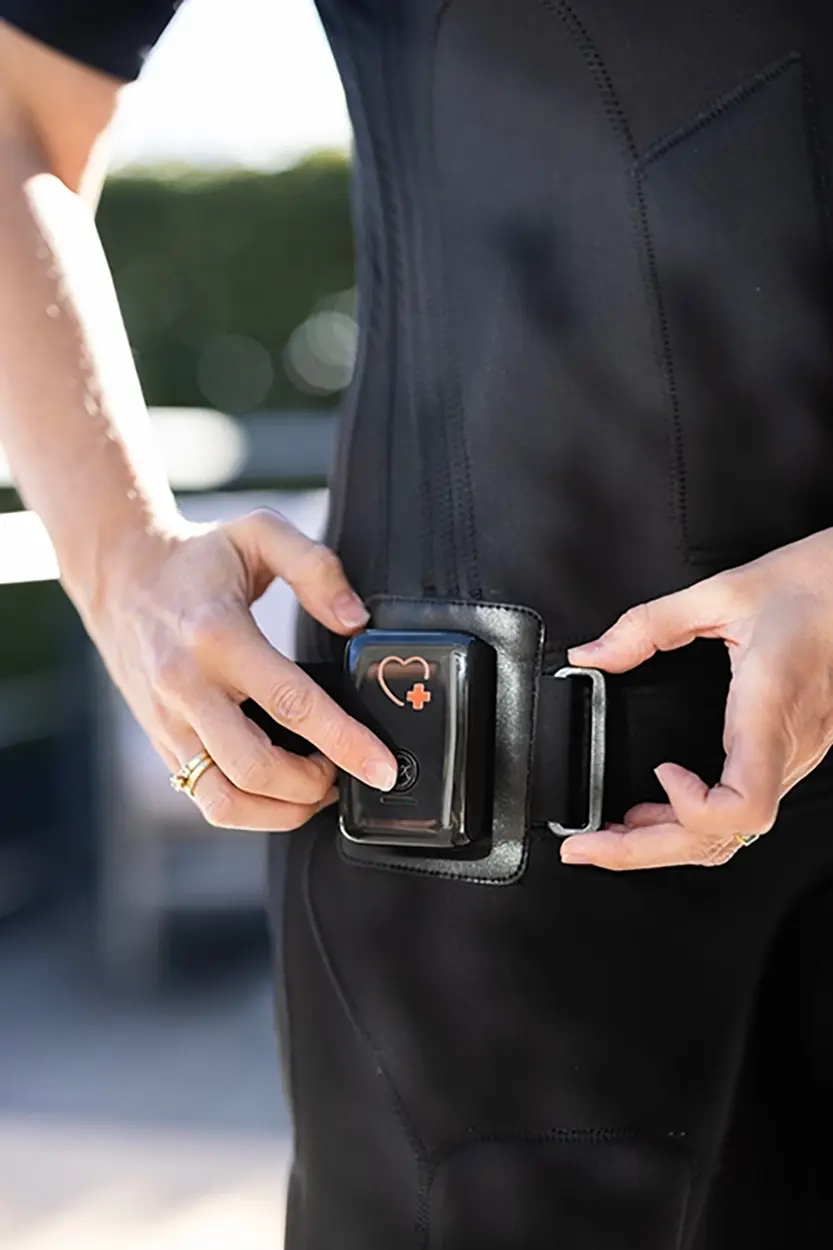
An EMS suit is equipment for electrical muscle stimulation, with electrodes built into a suit, vest or harness. When the suit is activated, electrical impulses are sent to the muscles, causing them to contract – just as they do when the brain normally sends signals through the nervous system.

Does EMS training work at all?
Yes – but many have overhyped it in their marketing and made questionable claims.
Several studies show that EMS can activate muscles effectively, and that the technology can:
- stimulate muscular activity
- maintain muscle mass
- improve muscle engagement
- be useful in rehabilitation and for people with reduced mobility
Why has EMS been criticised in the media?
In 2025, outlets including DR News scrutinised the EMS industry after several providers had marketed the claim that 20 minutes of EMS training was equivalent to 90 minutes of traditional training.
Several experts rejected this claim – including German professor Wolfgang Kemmler, who himself conducted one of the most widely cited EMS studies.
His assessment was clear:
20 minutes of EMS is not equivalent to 90 minutes of strength training.
Does that mean EMS training is a waste of money?
No. It means EMS should be used with the right expectations.
EMS training is not a miracle tool, and it cannot replace all other physical activity. But it can be an effective supplement – and in some cases a genuine alternative.
When does EMS training make sense?
EMS training may be relevant if you:
- have limited time and want to activate your muscles effectively
- find traditional strength training difficult because of joint problems, pain or previous injuries
- are undergoing rehabilitation (with approval)
- want better muscle engagement and activation
- want to supplement other training, not replace it
Several experts highlight the particular value of EMS for:
- older people
- people who are overweight
- people with reduced functional ability
- people who would otherwise not exercise
Here, EMS can be better than nothing – and in many cases a step towards more physical activity.
Are EMS suits safe to use?
For healthy people who use EMS with:
- moderate intensity
- sufficient rest (1-3 times weekly)
- correct setup
… EMS is generally considered safe.
However, EMS is not recommended in cases of:
- pregnancy
- a pacemaker
- serious heart or neurological conditions
- epilepsy
- fever or infection
A small number of cases of serious overexertion (such as rhabdomyolysis) have also been reported, typically involving excessive intensity without sufficient recovery – just as can occur with CrossFit and other high-intensity training.
So – does an EMS suit work?
Yes.
An EMS suit works for the purposes supported by evidence:
- muscle activation
- maintenance
- support for rehabilitation
- effective strength stimulation in a short time
But it does not work as a magical shortcut, and it should not be marketed as a replacement for all other exercise.
Used correctly – and with realistic expectations – an EMS suit can be a powerful and flexible training tool.
Summary of the criticism
Swipe sideways to see the full overview →
| Topic | What does the article say? |
|---|---|
| Does EMS training work? | Yes – when used correctly and with realistic expectations. |
| Documented effects | Muscle activation, maintenance of muscle mass, improved muscle engagement and support for rehabilitation. |
| Media criticism | Experts rejected the claim that 20 minutes of EMS is equivalent to 90 minutes of strength training. |
| What does the criticism mean? | EMS is not a miracle tool, but it can be an effective supplement or alternative. |
| When does EMS make sense? | When time is limited, for low-impact training, rehabilitation or as a supplement to other exercise. |
| Safety | Generally safe at moderate intensity with rest periods. Not recommended during pregnancy or with a pacemaker, serious illness, epilepsy or fever. |
Frequently asked questions about EMS training
Does EMS training work for building muscle?
EMS training can stimulate muscles and contribute to increased muscle activation and strength. Its effects depend on factors including intensity, training level and how regularly you train. EMS should be viewed as a form of exercise or a supplement to other strength training, not a shortcut to building muscle.
Is an EMS muscle stimulator the same as EMS training?
Not quite. An EMS muscle stimulator is typically used on individual muscle groups via electrodes, whereas EMS training often involves several larger muscle groups at the same time. With whole-body EMS, the electrical impulses are normally combined with active exercises and movement.
Does EMS training work for weight loss?
EMS training can increase muscle activity and energy expenditure during a workout, but weight loss primarily depends on your overall energy balance over time. EMS can therefore form part of an active lifestyle, but should not be seen as a standalone weight-loss solution.
What happens if you use EMS too often?
Muscles need recovery after EMS training, just as they do after other intensive exercise. Excessive intensity or insufficient rest between workouts can lead to significant muscle soreness and overexertion. Intensity should therefore be increased gradually, and your body should have time to recover between sessions.
Is EMS training safe for everyone?
No. EMS training is not necessarily suitable for everyone. People with conditions such as a pacemaker, epilepsy, serious illness or fever should not use EMS without an appropriate medical assessment. EMS is also generally not recommended during pregnancy. If in doubt, consult a doctor or another relevant healthcare professional.