If you are searching for an EMS training programme, you usually want to know exactly how to put a workout together in practice. Not just what EMS is, but which exercises to do, how long to train for, and what a programme might look like.
Here are 2 practical examples of an EMS training programme. The first is for beginners who want a simple way to get started. The second is for those who already have some experience and want a more intense workout.
EMS training programme example 1: For beginners
This programme is ideal if you are new to EMS training or want to ease into it. The focus is on getting your body used to the impulses and becoming familiar with the exercises.
- Frequency 2 times a week
- Duration 15-20 minutes per workout
- Focus Full body, muscle engagement and stability
Programme
- Squat 3 sets x 10-12 repetitions
Focus on thighs, glutes and core. 2. Stationary lunge 2 sets x 8-10 repetitions per leg
Focus on legs, glutes and balance. 3. Glute bridge 3 sets x 12-15 repetitions
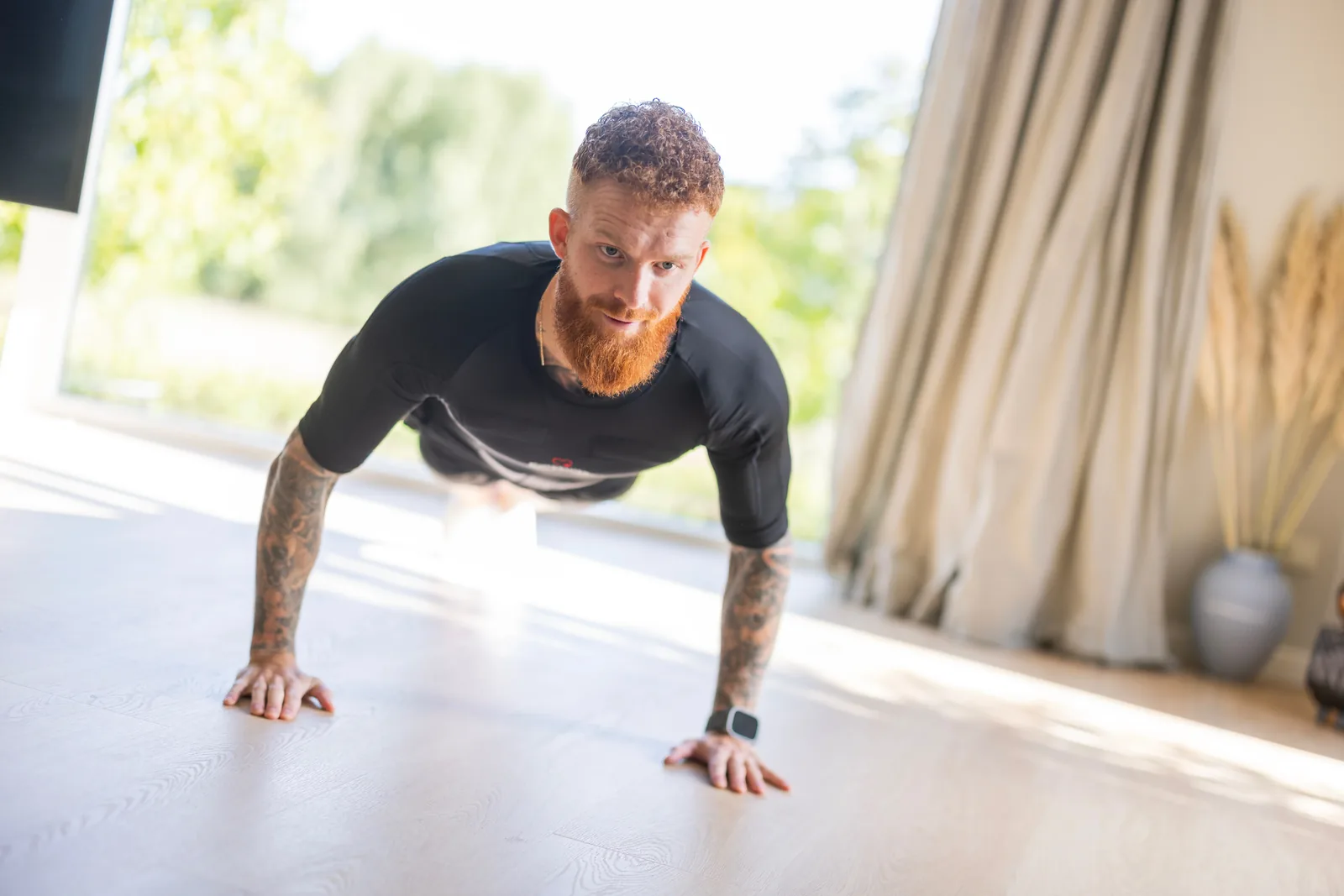
Focus on glutes and hamstrings. 4. Plank 3 rounds x 20-30 seconds
Focus on core and stability. 5. Standing row / arm contraction 2-3 sets x 10-12 repetitions
Focus on back, shoulders and arms.
Rest between exercises
30-45 seconds
How to use the programme
Start at a low to moderate intensity. The aim is not to push yourself to the limit from your very first workout, but to get to know your body and the equipment. If it feels too hard, it is better to turn the intensity down a little and maintain good technique throughout.
| Element | Details |
| Frequency | 2 times a week |
| Duration | 15–20 minutes per workout |
| Focus | Full body, muscle engagement and stability |
| Exercise 1 | Squat – 3 sets x 10–12 repetitions |
| Exercise 2 | Stationary lunge – 2 sets x 8–10 repetitions per leg |
| Exercise 3 | Glute bridge – 3 sets x 12–15 repetitions |
| Exercise 4 | Plank – 3 rounds x 20–30 seconds |
| Exercise 5 | Standing row / arm contraction – 2–3 sets x 10–12 repetitions |
| Rest between exercises | 30–45 seconds |
| Intensity | Low to moderate |
EMS training programme example 2: For those with a little more experience
This programme is better suited to those who have already tried EMS training a few times and want to focus more specifically on strength, tone and endurance.
- Frequency: 2-3 times a week
- Duration: 20-25 minutes per workout
- Focus: Full body at a slightly higher intensity
Programme
- Squat with a pause at the bottom 3 sets x 12 repetitions
Hold for 1-2 seconds at the bottom of each squat. 2. Forward lunge or stationary lunge 3 sets x 10 repetitions per leg
Focus on control and stability. 3. Glute bridge with a static hold at the top 3 sets x 12 repetitions
Hold for 2 seconds at the top. 4. Plank with shoulder taps 3 sets x 20-30 seconds
Focus on core, shoulders and body control. 5. Standing row / arm contraction 3 sets x 12-15 repetitions
Focus on upper body and posture. 6. Static wall sit 2-3 rounds x 20-30 seconds
Extra focus on thighs and endurance.
Rest between exercises
20-30 seconds
How to use the programme
The intensity can be more challenging here, but should still be controlled. You should clearly feel the effects of EMS training, but it should not be so hard that your technique suffers or your body cannot recover afterwards.
| Element | Details |
| Frequency | 2–3 times a week |
| Duration | 20–25 minutes per workout |
| Focus | Full body at a slightly higher intensity |
| Exercise 1 | Squat with a pause at the bottom – 3 sets x 12 repetitions |
| Exercise 2 | Forward or stationary lunge – 3 sets x 10 repetitions per leg |
| Exercise 3 | Glute bridge with a static hold at the top – 3 sets x 12 repetitions |
| Exercise 4 | Plank with shoulder taps – 3 sets x 20–30 seconds |
| Exercise 5 | Standing row / arm contraction – 3 sets x 12–15 repetitions |
| Exercise 6 | Static wall sit – 2–3 rounds x 20–30 seconds |
| Rest between exercises | 20–30 seconds |
| Intensity | Moderate to high |
Which EMS training programme should you choose?
That depends first and foremost on your level. If you are new to EMS, it makes most sense to start with the first programme. It offers a gentler introduction and makes it easier to notice how your body responds.
If you already feel comfortable with EMS training and have mastered the fit, intensity and exercises, you can move on to programme 2.
The most important thing is not to choose the hardest programme. It is to choose a programme you can actually complete and stick to.
What should a good EMS training programme offer?
A good EMS training programme should be simple enough to follow, yet structured enough for your body to benefit. This typically means:
- a small number of simple exercises
- a focus on the major muscle groups
- suitable rest periods between training days
- an intensity that challenges you without overloading your body
EMS training is intensive for the muscles, so more is not necessarily better. Most people get the most out of 1-3 workouts a week, depending on their level and recovery.
How often should you follow an EMS training programme?
For most people, 2 workouts a week is a good starting point. Some may benefit from 3, but this requires good recovery and an appropriately adjusted intensity.
EMS is not a type of training where working out every day necessarily makes sense. Your muscles need rest between sessions.
Common mistakes in an EMS training programme
One of the most common mistakes is starting too hard. Many people believe that the highest intensity delivers the fastest results, but it often simply leads to poorer technique and more unnecessary strain.
Another mistake is making the programme too complicated. EMS often works best with simple exercises that let you focus on muscle tension, control and correct execution.
Training too often without giving your body time to recover is also a mistake.
A useful tip before you start
If you use EMS at home, keep the programme simple at first. It is better to perform 4-5 exercises well than to squeeze in 10 without any structure. Once you have found your rhythm, you can always adjust the programme and build on it.